
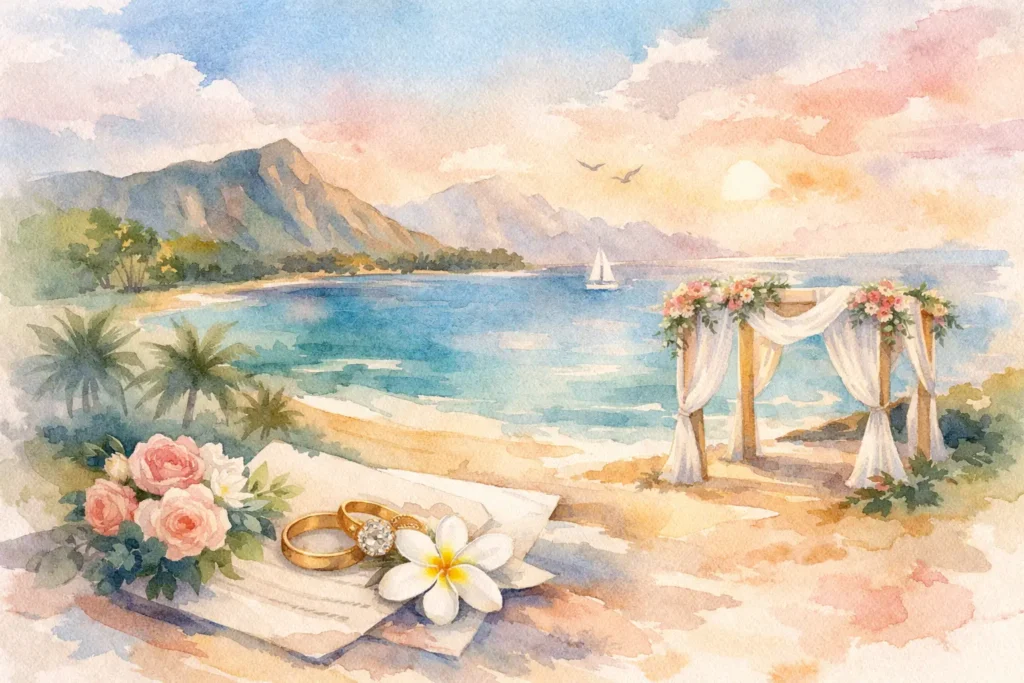
The waves are rolling in, your favorite person is holding your hand, and suddenly the words you meant to say all week seem to disappear. That is exactly why custom wedding vows help can make such a difference. Your vows do not need to sound like a movie script to be moving. They simply need to sound like the two of you.
For an intimate Oahu wedding or vow renewal, personal vows can become one of the most memorable parts of the day. A beach ceremony already gives you a beautiful setting. Your words are what make that moment unmistakably yours.
Why Personal Vows Feel So Meaningful
Traditional vows are beautiful for a reason. Their familiar promises carry weight, and some couples feel most comfortable speaking words that generations have shared. But custom vows create room for your own history: the long-distance years, the quiet kindness after a hard day, the way one of you always remembers the sunscreen, or the moment you knew you had found home in each other.
This is especially meaningful for destination weddings and vow renewals. You have chosen Hawaii because you want an experience, not a crowded ballroom routine. Saying a few honest words against the backdrop of the Pacific can make your ceremony feel less like an event on a schedule and more like a true pause to honor your relationship.
Personal does not have to mean deeply private. You can speak about the qualities you admire, the life you are building, and the promises you want to keep. Save stories that would embarrass your partner or confuse your guests for the reception, unless that is truly part of your shared sense of humor.
Custom Wedding Vows Help Starts With One Simple Question
Before trying to write something beautiful, answer this: what do I want my partner to feel when they hear me?
Maybe you want them to feel safe. Maybe you want them to know you are still choosing them after ten, twenty, or thirty years of marriage. Maybe you want to make them laugh through happy tears. That feeling is your compass. It keeps you from getting stuck trying to write a perfect speech.
Begin with a few notes, not full sentences. Think about when you met, what you have overcome together, what you love in the ordinary moments, and what you hope for next. A good vow often includes one detail that only your partner would recognize. It could be the early morning coffee they make before you are awake or the way they turn every wrong turn into an adventure.
Then choose two or three promises that are real enough to live by. “I promise to support your dreams” is lovely. “I promise to cheer for your next big idea, even when it begins with a dozen tabs open on the laptop” may feel even more like you.
A Simple Shape for Vows That Flow Naturally
Many couples struggle because they begin with a blank page and no structure. A gentle framework can make writing feel much easier without making your vows sound formulaic.
Start with a short reflection on your relationship or what your partner means to you. Follow it with a specific memory or quality you cherish. Then make your promises, and end with a simple statement of love and commitment.
It can be as brief as this in spirit: “From the day we met, you made life feel lighter. I love your steady heart and the way you find joy in small things. I promise to listen, to laugh with you, and to keep choosing our life together. I love you, and I am grateful to be your partner.”
That is enough. In fact, shorter is often stronger during an outdoor ceremony. On an Oahu beach, there may be wind, warm sunshine, passing waves, and a few emotions you did not expect. Vows that take about one to two minutes each give your words room to land while keeping the ceremony comfortable for everyone.
Keep the Tone Shared, Not Identical
Couples sometimes worry because one person writes something tender and poetic while the other is funny and plainspoken. You do not need matching sentences, matching lengths, or matching levels of sentimentality. You do want a shared understanding of the moment.
Talk beforehand about a few basics. Decide roughly how long you will speak, whether you will include humor, and whether you will mention children, family members, or loved ones who cannot be present. This quick conversation prevents one partner from delivering a three-minute tribute while the other has two lovely lines on an index card.
If one of you is a confident writer and the other freezes at the thought, do not turn this into a test. The less-comfortable writer can begin with spoken memories. Sit together over dinner, ask a few questions, and record the answers in a phone note. Honest spoken words often become the best written vows.
For Vow Renewals, Look Back and Forward
A renewal is not a second wedding. It has its own kind of beauty because it is rooted in a life you have already lived together.
You may want to acknowledge the years that have passed, the seasons that were easy, and the seasons that asked more of you. You do not have to share every challenge publicly. A simple phrase such as, “We have learned how to hold each other through change,” can say a great deal.
Then look forward. What do you want to protect in the next chapter? More adventures, more patience, more time together, more family dinners, or simply the promise to keep noticing each other? A vow renewal in Hawaii is a wonderful place to say, “I still choose you,” with the depth that only time can give.
Practice Without Trying to Perform
Read your vows aloud at least a few times. What reads well silently can feel awkward when spoken. Practicing lets you soften formal wording, notice sentences that run too long, and learn where you may need to pause.
You do not need to memorize them. Bringing a small printed card is thoughtful, practical, and completely appropriate. It also frees you to look at your partner rather than trying to remember every word. Choose a simple card or vow booklet that will be easy to hold in a beach breeze, and ask your coordinator or officiant where to place it before the ceremony.
If you know you are likely to cry, that is not a problem to solve. Pause, breathe, laugh if you need to, and let the moment be real. Your officiant can give you time. A ceremony does not lose its beauty because someone needs a few seconds to gather themselves.
When You Want Guidance, Ask for It
You are not supposed to plan every meaningful detail alone. A caring officiant can offer a ceremony structure, examples of vow styles, and reassurance about what will feel comfortable in the moment. They can also help you decide whether to share your personal vows privately before or after the formal ceremony if public speaking feels too vulnerable.
At Hawaiian Eye Weddings, couples can receive personal guidance as they shape a ceremony that feels warm, relaxed, and true to their story. Whether you are eloping with just the two of you or celebrating with a small group, the goal is never to make your words sound polished for someone else. It is to help you feel present enough to say what matters.
There is also a practical point to remember: your personal promises can sit alongside the traditional legal wording used during a wedding ceremony. If you are unsure how to combine the two, your officiant can explain the flow so you can focus on each other rather than ceremony details.
Give Yourself Permission to Keep It Simple
The best vows are not the longest ones. They are not the ones that use the biggest words or make every guest cry. They are the ones your partner recognizes as yours.
Write from the relationship you actually have, not the relationship you think a wedding vow is supposed to describe. A few clear promises, one true memory, and a wholehearted “I love you” can be more powerful than a page of carefully polished language. When you stand together in Hawaii with the ocean nearby, let the setting be grand. Let your vows be honest.