
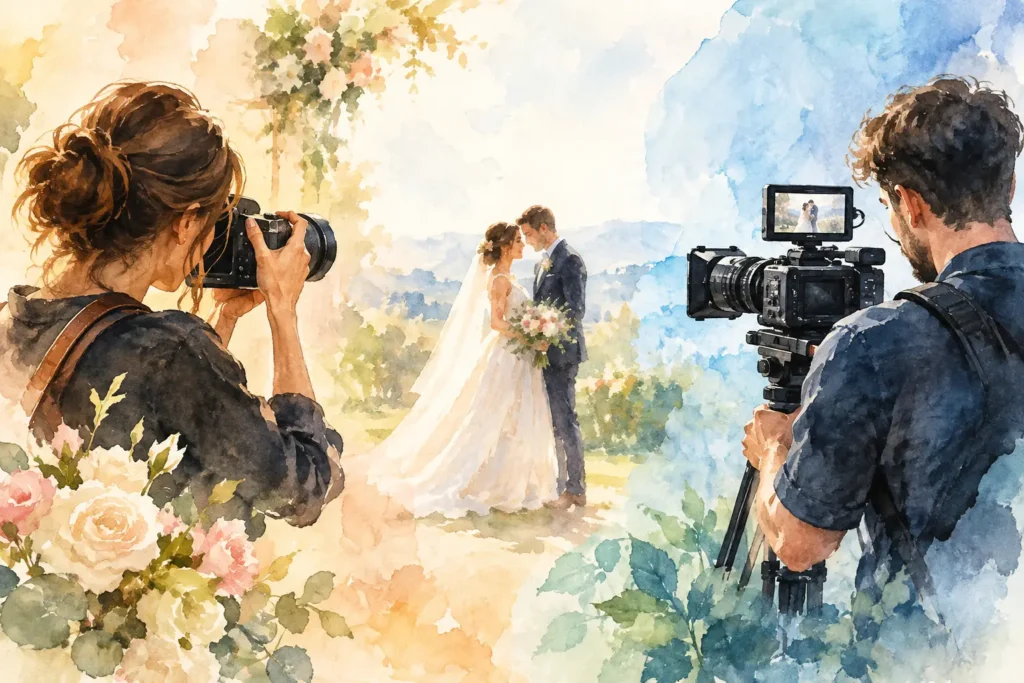
A wave folds onto the shore just as you say your vows. Your partner’s voice catches for a second. Your guests laugh when the officiant shares the story of how you met. These are the little moments that make a Hawaii ceremony feel entirely yours – and they are why choosing photography vs videography for your wedding deserves more thought than simply checking a box on a package.
Photos and films preserve a wedding in very different ways. Neither is automatically the better choice. The right one depends on how you want to remember your day, the rhythm of your ceremony, who will be sharing the moment with you, and the budget you have set aside for the memories that will last long after your tan fades.
Photography vs Videography for Your Wedding: The Real Difference
Wedding photography turns fleeting moments into images you can return to again and again. A still photograph captures the sweep of your dress in the ocean breeze, the flower lei around your neck, your hands meeting during the ring exchange, and the color of an Oahu sunset behind you. It lets you pause. You can frame an image, place it in an album, send it to family, or glance at it on an ordinary Tuesday and be right back on the beach.
Videography preserves movement, sound, and atmosphere. It brings back the words you promised each other, the Hawaiian music playing before the ceremony, the soft break of waves, and the look on your faces when you are pronounced married. A film is especially powerful for couples who want to hear their vows again or include loved ones who could not travel to Hawaii.
Think of photography as the art of choosing the defining instant. Think of videography as the feeling of reliving the experience. Both can be deeply emotional, but they do different jobs.
When Wedding Photography May Be the Best Fit
For many intimate weddings and vow renewals, photography is the first priority. A skilled photographer can document the ceremony, guide you into flattering light, and create relaxed portraits that show both your connection and the beauty of the island. This matters on a beach, where the location is part of the story rather than just a backdrop.
Photography is also wonderfully easy to share. A few favorite images can travel quickly to parents, children, friends, and coworkers back home. Couples often use their photos for announcements, holiday cards, thank-you notes, printed albums, and framed artwork. If your ceremony is a quiet elopement with just the two of you, still images may be the most natural way to tell the story.
There is a practical consideration, too. Photography generally gives you more individual keepsakes from a short event. Even a simple beach ceremony can produce portraits, candid reactions, detail shots, and scenic images across a gallery. If you are working with a firm budget and must choose one service, photography often offers the broadest day-to-day value.
That said, photographs cannot capture the sound of your partner saying, “I do.” If hearing the words and feeling the pace of the ceremony is central to you, video may deserve equal weight.
When Wedding Videography Is Worth Prioritizing
Videography can be an especially meaningful choice for a destination wedding. Hawaii is a place many loved ones dream of visiting, but travel schedules, costs, health concerns, and family obligations can make attendance impossible. A thoughtfully edited ceremony film gives those people a genuine way to experience what they missed. They can hear the vows, see the setting, and witness the emotion in a way photos alone cannot fully convey.
Video is also a lovely option for vow renewals. You already have years of shared history behind you, and your renewal promises may carry a depth that is hard to explain in a single image. Hearing each other speak those words, with the ocean and the people closest to you nearby, becomes a keepsake for your future selves and for your family.
Choose videography if you know you are sentimental about voices, movement, music, and spontaneous reactions. Perhaps your child will walk you down the beach, a parent will offer a reading, or you have written vows that took months to prepare. Those moments are made for film.
The trade-off is that a video asks you to sit down and watch. It is not as instantly visible as a framed photograph, and the final experience depends on clean audio, thoughtful editing, and a ceremony that leaves room for the story to unfold. It is a beautiful investment, but it is best chosen because you truly want the experience of reliving the day – not because it feels like something every wedding is supposed to have.
Why Many Oahu Couples Choose Both
If your budget allows, photography and videography work best as companions, not competitors. Your photos become the lasting visual record of your favorite details and portraits. Your film holds the living heartbeat of the ceremony. Together, they give you both the polished image and the unscripted moment behind it.
This combination is particularly fitting for beach ceremonies, where conditions can change quickly. A sudden breeze, a passing rainbow, or a lively wave can create a moment that is impossible to plan. A photographer may capture the perfect still image, while video reveals the laughter that followed. Neither replaces the other.
Choosing both does not mean your ceremony needs to feel large or overly produced. For an intimate wedding, the best coverage is often quiet and unobtrusive. You should feel present with one another, not like you are performing for the camera. Let your planning team know whether you prefer gentle guidance for portraits, candid coverage, or a balance of both.
How to Make the Decision Without Second-Guessing
Start with one simple question: what do you most hope to revisit five, ten, or twenty years from now? If the answer is the way you looked at each other against the blue water, photography may be your must-have. If the answer is the sound of your vows and the joy in your loved ones’ voices, prioritize videography.
Then consider who will be part of the day. Couples eloping privately may lean toward photos and a beautiful portrait session. Couples with children, parents, or guests who cannot attend often find that video becomes a gift for everyone. There is no wrong answer, and a smaller ceremony is not less worthy of being filmed.
It also helps to think about your wedding timeline. A short, simple ceremony can still be beautifully documented, but be realistic about what you want included. If you dream of sunset portraits, spoken vows, guest messages, and scenic footage from several locations, allow enough time and budget for that vision. If you want a relaxed ceremony followed by a few heartfelt portraits, a focused photography package may be perfect.
Ask clear questions before you book. Find out what is included, how many edited photos or what type of film you will receive, whether ceremony audio is recorded, and when you can expect delivery. Fast communication and transparent details make a meaningful difference when you are planning from the mainland or coordinating travel.
Give Yourselves Permission to Choose What Feels Personal
A wedding memory does not become valuable because it follows someone else’s checklist. Some couples will treasure a single sunrise photograph more than anything. Others will watch their ceremony film every anniversary, listening for the ocean behind their promises. Both choices honor the day.
At Hawaiian Eye Weddings, we believe the best keepsakes come from a ceremony that feels calm, personal, and true to the two of you. Choose the coverage that lets you be fully present in paradise, then trust that the moments you create together will be worth remembering.