
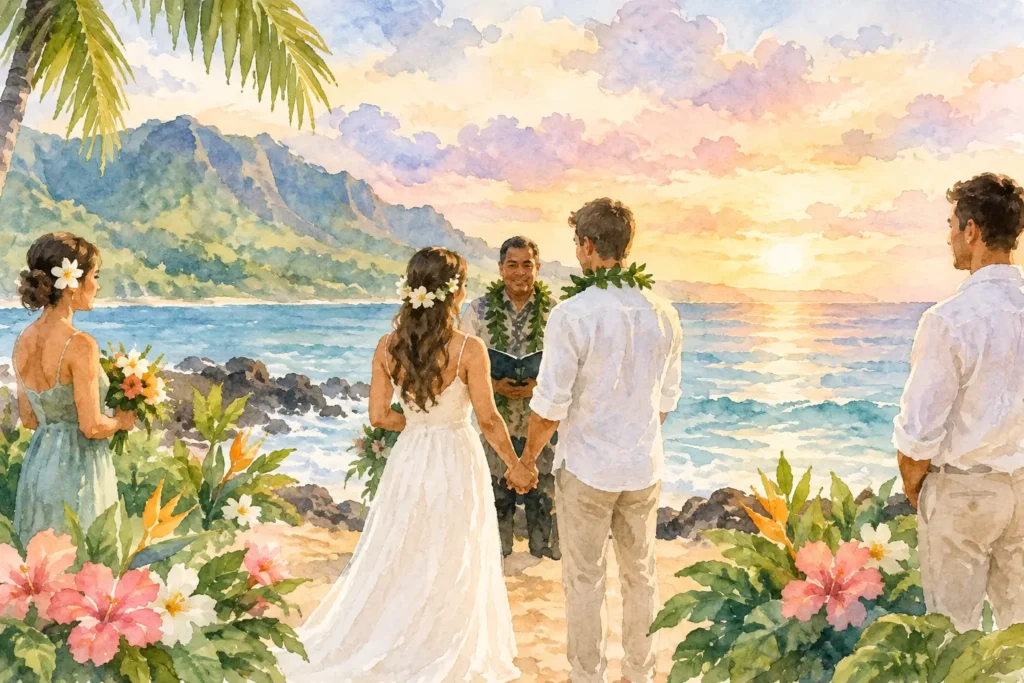
Picture the moment: you and your partner are standing on an Oahu beach, waves folding onto the shore, with only your officiant and a photographer nearby. Then a practical question pops up: are witnesses required to make your Hawaii wedding legal? For couples planning an intimate destination ceremony, the answer is wonderfully simple.
Are Witnesses Required for a Legal Hawaii Wedding?
No. Witnesses are not required for a legal marriage in Hawaii. You do not need to bring two friends, ask strangers on the beach, or add guests to your plans simply to satisfy a legal requirement.
That freedom is one reason Hawaii is such a natural fit for elopements and small weddings. If your dream is a private sunrise ceremony, a just-the-two-of-you exchange of vows, or a celebration with a handful of your closest people, you can choose the guest count that feels right for your relationship.
A legal Hawaii marriage does still require a few essentials. Both partners need to obtain a Hawaii marriage license before the ceremony, and the ceremony must be performed by an authorized Hawaii marriage performer. Your officiant then completes the required marriage documentation after the ceremony. The witness signature line many couples expect from weddings in other places is simply not part of the Hawaii requirement.
What You Do Need to Get Married in Hawaii
The absence of a witness requirement keeps things easy, but it does not mean there is nothing to prepare. A little advance planning protects the relaxed, joyful feeling you came to Hawaii for.
First, apply for a Hawaii marriage license before your wedding day. Couples can begin the process online, but both partners must appear in person before a licensed marriage agent to receive the license. Bring the identification requested for your appointment and make sure the names on your application match your documents.
Your marriage license is valid for 30 days from issuance, so it is wise to arrange your appointment early enough to avoid stress but not so early that it expires before your ceremony. There is no waiting period once the license has been issued. If your travel plans allow, many couples schedule the appointment shortly after arriving on Oahu.
On the ceremony day, you will need your valid license and an authorized officiant. Your officiant guides the legal portion of the ceremony and handles the filing process afterward. Your original marriage certificate is then available through the State of Hawaii once the marriage has been recorded.
Requirements and appointment procedures can change, especially around state holidays and busy travel seasons. Confirm the current details before you travel, and give yourself a little room in your itinerary. That one small step makes it much easier to be fully present when you step onto the sand.
Why Couples Often Bring Guests Anyway
Witnesses may not be legally necessary, but guests can still be deeply meaningful. A parent helping with a lei, children scattering flower petals, or a best friend quietly wiping away happy tears can make a small ceremony feel wonderfully complete.
The difference is that your guest list is now a personal choice, not paperwork. You can invite the people who truly belong in the moment and leave behind the pressure of building a crowd. For some couples, that means a circle of family. For others, it means nobody else at all.
If you are eloping, a photographer and officiant can still help create a sense of occasion without making the experience feel public. You will have beautiful images, your vows, and the memory of a ceremony shaped around the two of you.
Are Witnesses Required for a Vow Renewal?
Witnesses are not required for a Hawaii vow renewal either. More importantly, a vow renewal is not a legal marriage ceremony, so there is no marriage-license process to complete in the first place.
That gives you even more creative freedom. You can renew your vows barefoot at the waterline, include your children in a family blessing, exchange new rings, read letters to each other, or keep it beautifully simple with a few personal words at sunset. There are no legal forms dictating who must attend or what the ceremony needs to include.
For many couples, this is the real beauty of a Hawaii renewal. You are not recreating your wedding day. You are honoring everything that has happened since it: the years of partnership, the hard seasons you made it through, the adventures you have shared, and the promise you are choosing again.
Legal Wedding or Symbolic Ceremony: Choose What Feels Best
A legal Hawaii wedding is ideal for couples who want their Oahu ceremony to be the day they officially marry. It is a straightforward choice when you are ready to complete the marriage-license process during your trip.
A symbolic ceremony may suit couples who have already completed the legal paperwork at home, have a tight travel schedule, or simply want a meaningful celebration without administrative tasks. The ceremony can still be emotional, personal, and every bit as beautiful. The difference is only in the legal status, not in the love behind it.
Some destination couples choose to marry legally in their home state before traveling, then hold their true celebration in Hawaii. Others prefer to make their beach ceremony the legal event. Neither choice is more romantic than the other. The best choice is the one that lets you arrive calm, prepared, and excited.
Planning an Intimate Oahu Ceremony Without the Stress
When your wedding is small, every detail is more visible. That does not mean it needs to be complicated. It simply means the details should feel intentional.
Start with the atmosphere you want to remember. Do you picture a quiet morning beach with soft light and few people around? A golden-hour ceremony with the ocean behind you? A lush garden setting with family close by? Your location and timing influence everything from photographs to privacy to how formal you want to dress.
Then decide who, if anyone, you want beside you. Since witnesses are not required, this decision can come from the heart. You might include only your children, invite a few loved ones, or protect the moment as a private elopement. There is room for all of it in Hawaii.
Finally, choose support that makes the logistics feel lighter. A ceremony team can help coordinate the officiant, marriage-license guidance, florals, music, photography, transportation, and the little timing details that are easy to overlook from thousands of miles away. Clear pricing and responsive communication matter because they let you focus on the reason you chose this trip in the first place.
At Hawaiian Eye Weddings, we love helping couples create ceremonies that feel personal rather than packaged, whether that means a simple legal elopement or a heartfelt vow renewal with family nearby. Your ceremony should reflect your story, not a checklist someone else wrote.
A Few Common Questions About Hawaii Wedding Witnesses
Can our photographer be a witness?
You do not need a witness for a legal Hawaii wedding, so your photographer does not need to pause their work to sign paperwork. They can stay focused on documenting the expressions, embraces, and ocean-view moments you will want to revisit for years.
Can we get married with only an officiant present?
Yes. As long as you have completed the required marriage-license process and your ceremony is performed by an authorized Hawaii officiant, a just-the-two-of-you ceremony can be legally valid. Your officiant is there to perform the marriage, not to serve as a witness.
Do we need to bring our marriage license to the ceremony?
Yes. Your license is an essential part of a legal Hawaii wedding. Keep it somewhere safe and easy to access on the day, and follow your officiant’s guidance about when to provide it.
What if we want a friend or family member to officiate?
The person performing a legal Hawaii marriage must be authorized by the state. A loved one can absolutely share a reading, offer a blessing, walk you down the aisle, or take part in the ceremony in another meaningful way. For the legal portion, make sure your officiant is properly authorized.
Your Hawaii ceremony does not need extra people or extra complications to be real. Bring the documents you need, choose the people you love, and leave space for the part you will remember most: looking at your partner with the Pacific behind you and knowing you chose this moment together.